 3 Oct
3 OctAbout the Company

AI-powered Software Agents

2-10

Delaware, USA
BotGauge AI is a next-generation AI-powered test automation platform founded in 2024. By leveraging in-house Natural Language Processing (NLP), BotGauge enables teams to create software test cases using plain English reducing testing cycles, improving quality, and lowering engineering effort.
As an early-stage company with ambitious growth goals, BotGauge’s platform reliability and execution speed are central to customer experience and adoption.
Services Used
 CloudVictor - DevOps as a Service
Key Results
- Faster execution start times (Reliability & Performance)
- Lower operational overhead with stronger security (Operational Excellence)
- Elastic scale without idle infrastructure (Cost Savings)
"As an early-stage AI company, we needed an execution platform that could scale instantly without adding operational complexity. CloudVictor helped us build a modern AWS foundation that’s fast, secure, and ready for growth without slowing down our product team. "
Sreepad Krishnan Mavila
Cofounder, BotGauge

BotGauge Business Problem
BotGauge’s core workflow involved orchestrating large volumes of customer-submitted test cases. As BotGauge began onboarding early customers, their platform faced a familiar startup tension:
- Execution latency under parallel demand
Customers require fixed SLAs for Task Startup but experienced a noticeable varying delay between user request and actual execution start, averaging over 22 seconds in early POC testing, with higher delays under higher concurrency load. - Scaling tied to pre-provisioned capacity
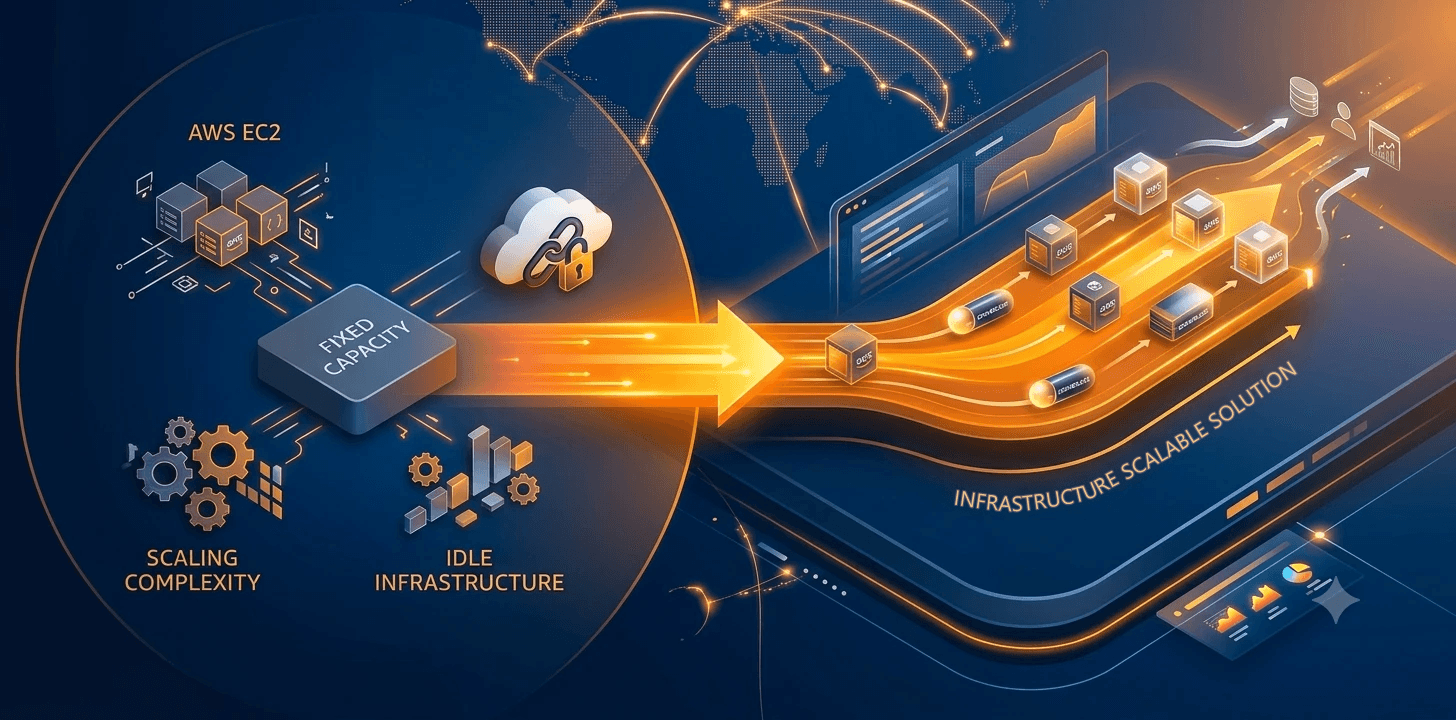
Customer demand became spiky. Execution workloads depended on EC2-backed capacity that had to be sized in advance, creating either idle infrastructure during less traffic or scaling risk during spikes. This also became an operation burden. - Operational complexity for a lean team
Managing nodes, scaling policies, patching, and failure scenarios added operational overhead that competed for dev team bandwidth directly with product & feature development. - Rising security and reliability expectations
As BotGauge matured, customers expected stronger isolation, predictable behavior during failures, and production-grade security controls by default.
The trigger for change:
Botgauge was planning to launch an “unlimited” plan, where customers would be able to submit a large number of workloads in big batches and expect their executions to start within a defined SLA. They needed a truly “elastic” system which would scale up reliably with an SLA whenever a big batch is submitted, execute the workloads and release the capacity and reduce the operational burden on a small engineering team without rewriting core application logic.
This inflection point led BotGauge to partner with CloudVictor to modernize their platform and build a foundation designed for speed, elasticity, and long-term maintainability.
Analysis
Before re-achitecting the execution platform, CloudVictor worked closely with the BotGauge team to their platform’s architecture & execution behavior under real-world usage to spot constraints limiting scalability and efficiency
The objective of this phase was not to compare architectures visually, but to define a target-state execution model that could meet BotGauge’s performance, scalability, and operational goals without disrupting existing workflows.
Understanding BotGauge’s current workflow - Baseline
- Mapped the end-to-end lifecycle of customer-submitted workload executions - from user request -> orchestration -> container startup -> execution completion.
- Identified two distinct execution profiles:
a. Generative workload request requiring pre-warmed, pre-provisioned capacity for near-instant execution.
b. Execution workload request that were less time-sensitive but highly parallelizable and ideal for on-demand execution. - Collected baseline performance signals during controlled testing:
a. Average request-to-execution start delay: 74.08 seconds.
b. Maximum observed delay: 92.62 seconds under 200 parallel execution requests. - Evaluated how this behavior impacted:
a. customer experience during high concurrency.
b. infrastructure utilization during idle periods.
c. operational effort required to manage scale.
This helped us in 2 ways:
- Define the exact boundary of modernization: What should change and What should remain untouched.
- Baseline measurements strictly as input signals to guide the final architecture design.
Constraints and risks identified during analysis:
Other than the traditional risk & issues associated with static provisioned capacity:
- Generative workload requests are much lesser than Execution workload requests. Customers use Generative workload requests to generate a template and then keep executing them using Execution workload requests.
- Node-level responsibilities increased operational load for a lean engineering team.
- Security, isolation, and failure recovery needed to be stronger as customer usage grew
Solution
Target Architecture
Based on this analysis, CloudVictor and BotGauge aligned on a clear target-state approach:
- Design an on-demand, serverless container execution model for Execution workload requests. This needs to run in parallel with the existing platform, sharing the network resources like VPC, subnets, NAT Gateways.
- Decouple Execution workload requests from current fixed infrastructure capacity & migrate it to new serverless model.
- Standardize provisioning using Infrastructure as Code (AWS CDK).
- Establish a strong baseline for:
- Security: Least-privilege based permission model.
- Resilience: Execution environment and network isolation for each task.
- Reliability: Automated recovery in case of capacity issues.
- Observability: System health visibility using dashboards.
- Operational Readiness: Alarms on certain identified error conditions.
- Automation: Repeatable, controlled & automated deployments
With the target execution architecture, requirements & constraints clearly defined, CloudVictor executed the modernization in controlled, phased steps ensuring BotGauge could integrate, test, and launch without disrupting current production OR ongoing product development.
The focus throughout was simple: deliver elastic execution, reduce operational load, and standardize delivery & monitoring without forcing application rewrites.
Execution Platform
Below is the target execution architecture designed and implemented by CloudVictor for BotGauge’s execution workloads.
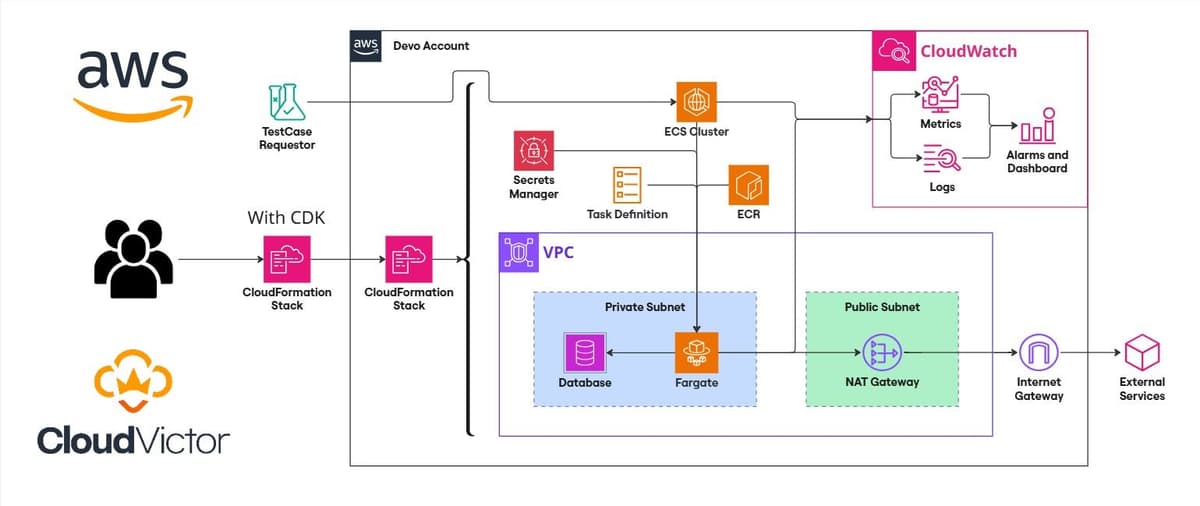
- Serverless container execution using Amazon ECS with AWS Fargate Execution Requests run their own isolated containers on fargate, eliminating the need for pre-provisioned compute while supporting high parallelism.
- Infrastructure as Code using AWS CDKAll infrastructure is defined, versioned, and deployed consistently across environments, minimizing configuration drift and manual errors.
- Secure, production-grade networking
a. Workloads run in newer purpose-built private subnets for maximum security.
b. Controlled outbound access via existing NAT Gateways.
c. Integrated with existing VPCs. - Container supply chain built for scale
a. Docker images stored and managed in Amazon ECR.
b. Dockerfile treated as a clear contract between application and infrastructure - Secrets and configuration management
a. Sensitive credentials and environment variables managed through AWS Secrets Manager.
b. Fine-grained IAM policies enforced for least-privilege access.
CI/CD automation and delivery pipeline
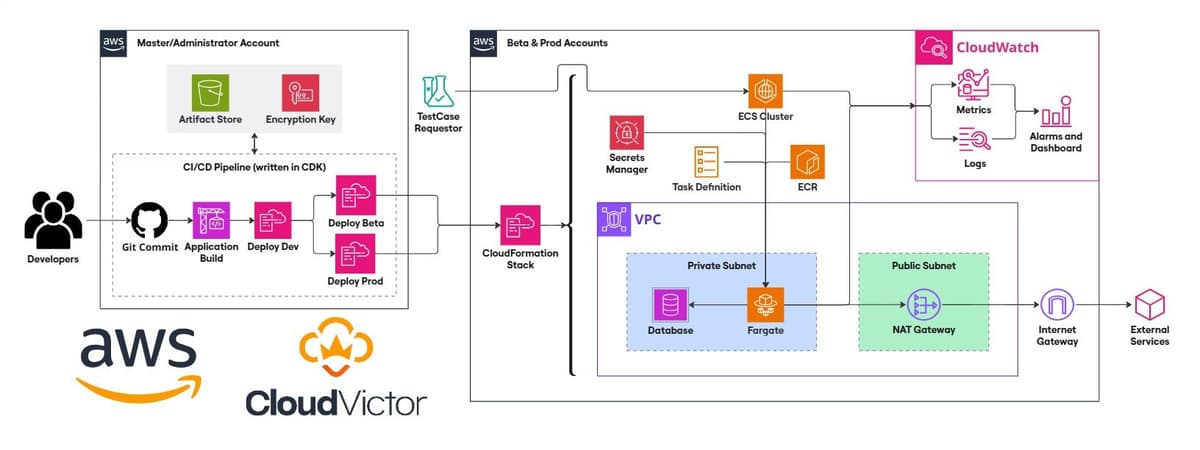
Diagram illustrates the CI/CD pipeline designed and implemented by CloudVictor to automate builds and deployments across environments.
- GitHub-triggered CI/CD pipeline using AWS CodePipeline
a. Automated container builds and validations via CodeBuild
b. Consistent deployments across staging and production environments - Pipeline defined as code
a. CI/CD infrastructure itself managed through IaC
b. Enables repeatability, governance, and easy extension to new environments or regions - Approval gates and deployment controls
a. Clear stage boundaries for future integration test automation and compliance workflows
Observability and operational readiness
- Centralized logging, metrics, and alarms with CloudWatch.
a. Real-time visibility into execution health and system performance. - Distributed tracing using AWS X-Ray.
a. Faster debugging and performance analysis for execution workflows. - Dashboards designed for both system and business metrics.
Phased execution approach
- Discovery & assessment: Workflow understanding, Baseline metrics collection, Access provisioning.
- Architecture design: Task sizing, Scaling policies, IAM, Networking.
- Staging rollout: Full stack deployed for Integration and Testing.
- CI/CD Setup: Automated build and deployment pipelines.
- UAT & Migration: Load testing, Performance validation, Rollback planning.
- Production launch: Controlled rollout with monitoring in place.
- Post-launch support: Rollout complete, Documentation, and Knowledge transfer.
This phased approach ensured BotGauge gained the benefits of a modern execution platform without compromising reliability or developer velocity.
Final Outcome
Following the successful implementation of the new execution platform, BotGauge now operates on a modern, production-ready AWS foundation designed for scale, efficiency, security, reliability and long-term maintainability. It delivered a clean separation between core product execution and underlying infrastructure.
Technical outcomes achieved:
- On-demand execution at scale
Execution workloads now run on serverless containers that scale automatically with incoming requests, without relying on pre-provisioned compute capacity. - Improved execution start SLAs under high concurrency
The new architecture is designed to minimize request-to-execution start delays, even during high parallel workloads. - Standardized, repeatable deployments across environments
Infrastructure defined entirely through AWS CDK ensures consistent deployments across staging and production environments. - Reduced operational complexity
Removal of EC2 node management, patching, and scaling responsibilities allows the dev team to focus on product development. - Built-in observability and resilience
Centralized logging, metrics, alarms, dashboards, and distributed tracing provide continuous visibility into system health and execution behavior.
This foundation positions BotGauge to evolve execution workflows confidently as customer usage and workload complexity grow.
Business Outcome
By modernizing its execution platform, BotGauge has built a foundation that supports growth without increasing operational complexity. What began as an infrastructure initiative now directly strengthens the company’s ability to scale its product and serve customers reliably.
Business impact delivered:
- Scalability without proportional cost growth
Execution workloads now scale only when customer demand exists, reducing the wasted dollars for idle infrastructure as usage grows. - Faster path from product innovation to customer value
With infrastructure management automated and standardized, the dev team can focus more time on improving core AI-driven capabilities rather than DevOps work. - Increased platform confidence for customer adoption
A resilient, observable execution layer helps BotGauge scale customer adoption curve and handle parallel workloads reliably. - Enterprise-ready foundation for future growth
Strong security controls, SOC2 compliant architecture, controlled deployments, and disaster recovery readiness positions BotGauge to meet the expectations of larger customers as the business scales.
If you’re a founder or CTO facing similar challenges scaling cloud workloads, reducing operational drag, or modernizing AWS without risking stability, CloudVictor can help.
We work closely with lean engineering teams to design and implement production-grade AWS platforms that are secure, scalable, high-performance, disaster resistant and cost-efficient, delivered through a phased, low-risk approach. From architecture and IaC to CI/CD and observability, we take ownership end-to-end so your team can stay focused on building the product.
Thinking about modernizing your AWS stack? Talk to a Solution Architect Expert. We’re here to help you move faster, scale confidently, and build for what’s next.